
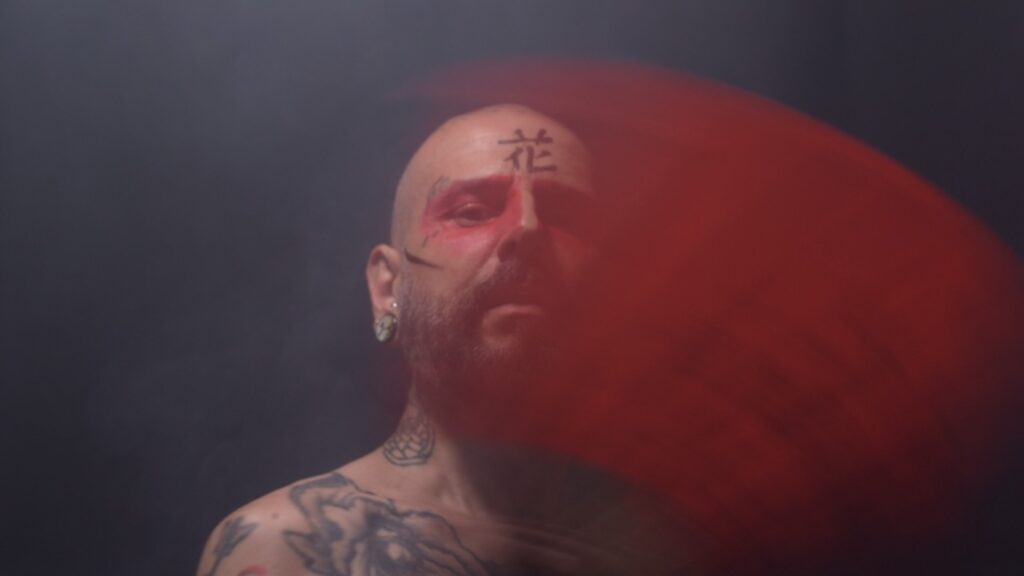
The Pan Eros Film Festival sat down with the director of VENUS REBIRTH, Domiziano Christopharo, to discuss his film, its inspirations, and the struggle with censorship. Excerpts of the interview can be seen in the Exhibition Filmmaker Spotlight from this year! Full interview is below.
Interviewed by Brodin Petrichor
Transcription by Keri Grassl-Ziegler
PEFF: Domiziano, why don’t you tell us who you are and a little bit about your background. So happy you could be here with us today.
Domiziano Christopharo: I’m happy to be here. I’m happy to participate in the festival, especially with short films. So rare, so different, these films usually will not be accepted by other festivals.
So my background, I was born an actor and I’m a dancer of Butoh. That is a Japanese traditional dance. And my background is more about stage and also with Japanese culture that can be visible in my segment, VENUS REBIRTH that is screened at the festival. I became popular with directing horror movies that became cult favorites.
So I’m popular in the extreme fields. And then we arrived at Phallacies which is an anthology like the title suggests, where the protagonist of each segment is the penis. My segment is a part of this movie.
It is a movement, not just an anthology film, where 13 artists of the underground try to fight censorship in culture and social media. Nudity can be art, sex can be art, eros is art. So we try to make this movie that has the protagonist, the penis, the penis as a member of the cast and also has a central part of the story. Of course we had [a lot of] trouble promoting the movie because we were rejected by many festivals. Also just the title Phallacies was shadowbanned on Instagram and Facebook. So we had many, many problems.
We are in a society that, culturally in this moment, is really fucked up. So we welcome a festival like this that keeps reminding the audience that yes, the beauty of the body, the natural feelings, the eros, and the sex can be part of the natural expressions of the society.
PEFF: You have a big background in horror filmmaking. I would love to hear a little bit more about how VENUS REBIRTH began.
Domiziano Christopharo: Well, it is a kind of homage to Japanese culture and modern manga, but also the science fiction movies from the 60s and 70s, and also body horror. It is a mix of influences. There is a little bit of Lovecraft too. The idea of when I had to do the segment for the movie, and you know, the penis must be the center of the story in some way. I asked, what kind of story can I tell?
Finding actors for these scenes is very difficult. So I used myself because it was easier. I totally trust what I do. So it was not a problem to put myself in front of the camera, even if I normally prefer to stay behind.
The idea is an alien invasion takes over the body and uses sex to make you think. I think that the story can be read in many ways because it can also be a toxic relationship. These men become totally controlled by this plant that has a flower that sometimes looks like a vagina, sometimes like an anus. Anyway, it’s something very anatomic and this plant releases an essence that is like a drug for this man that starts to have sex with the plant, feeding the plant with his semen till it gives birth to a new species.
So yes, the idea was to do something funny, something visually appealing for me. I didn’t want to just use nudity. I wanted to show something interesting to see. That’s why I chose landscapes in the desert, in the sea.
Making the plant also was funny. Was not very comfortable to have sex with, but was funny to make it.
PEFF: I will say, it’s a very beautiful film. This is beautifully shot. I could see your influences with “Lovecraftian” and some Junji Ito, especially with all the body horror. It seems like you have a lot of history with props, prosthetics, etc. The film is so gooey and I could almost feel it. Do you do prosthetics and props yourself?
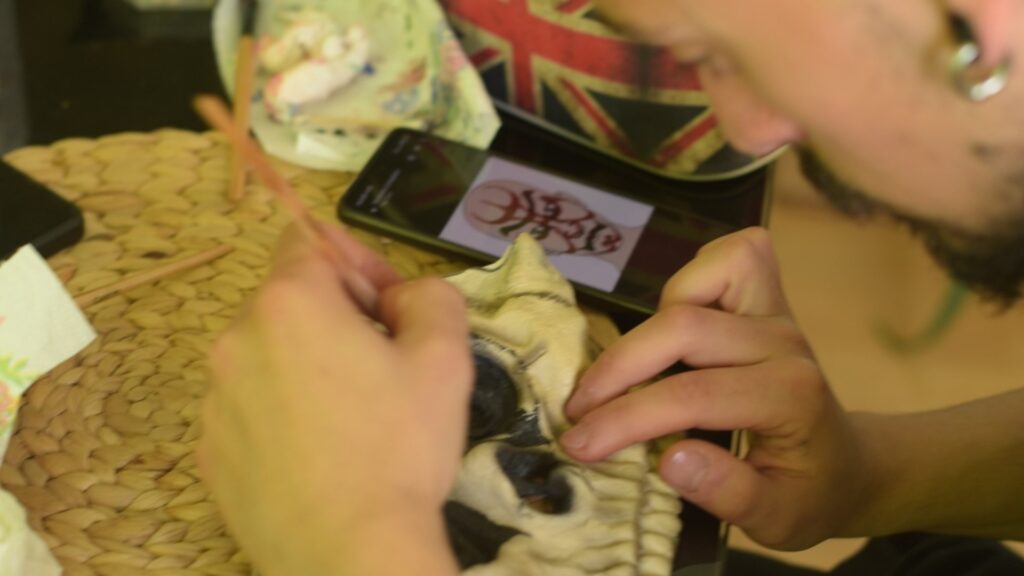
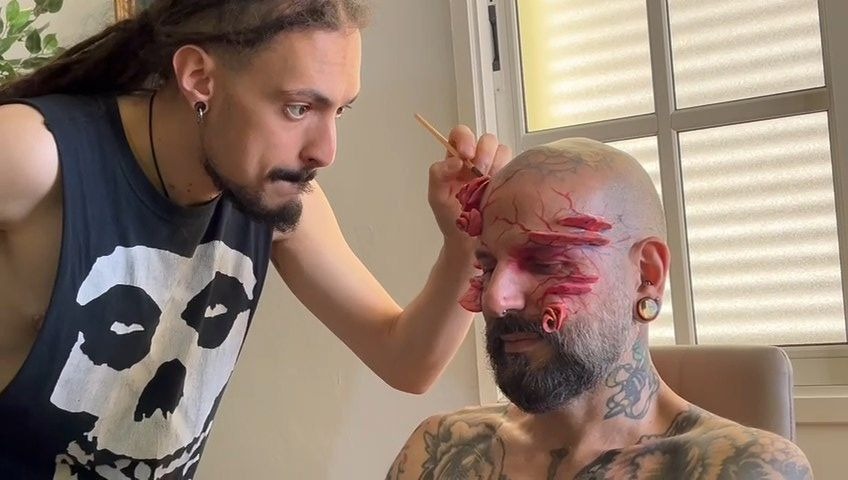
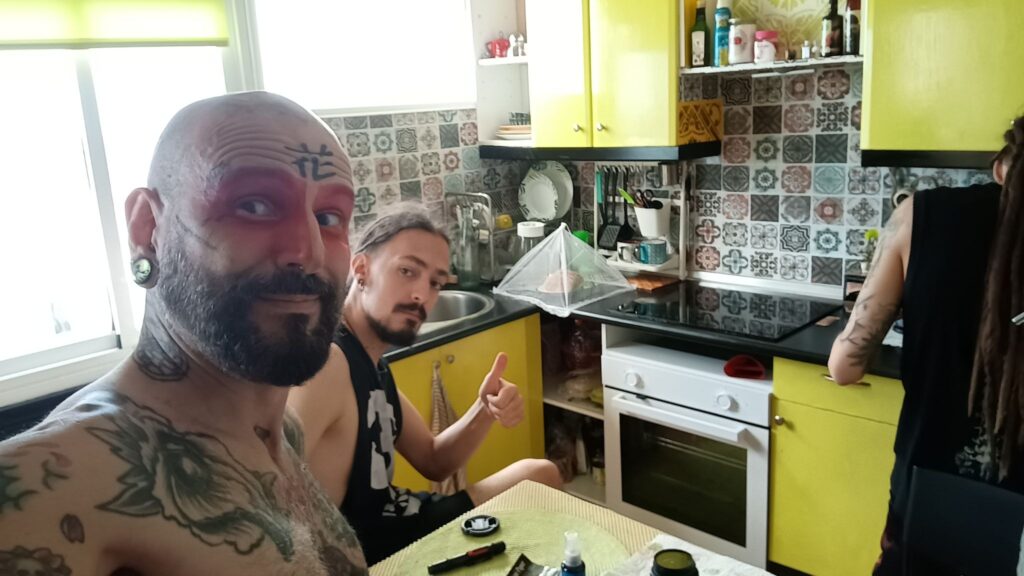
Domiziano Christopharo: Well, you can imagine the segment was filmed with just three people. It was me, the actor, then there was an assistant director, the DSA director himself. I care about cinematography, some of the effects. So it’s very difficult to split yourself behind the camera and in front. And then there was Kevin Capuro, a makeup artist that did some of the makeup.
So the result is a coordination of just three people. I did almost everything you see in the film. The costumes, the lighting, the props, the plant. And Kevin helped me with the prosthetic that actually was clay. Clay, modeled in the moment for this effect, when I start to become like a plant. This makeup of the Japanese masks and the mushrooms starting to grow on the face. I loved the idea of this contamination that turned the body into something that at first is scary, and then the character becomes sad, just accepting the change. But from this change, something new is born. So not necessarily a negative, it’s a new life.
Also, the concept is very similar to Body Snatchers. The plants replace the humans, keeping the same aspect, but they are just without emotions because emotions for them, for the aliens, are the real trouble of the human. The perfect society for them is to keep your memories, keep your passions, but without emotions. So that was an interesting point too. In this case, maybe it’s different. You lost your body, but you kept your passion.
PEFF: There’s a lot of themes with nature. I was wondering if this is a common theme that you tie into a lot of your work, does it tie in with your history, the connection to the plant world?
Domiziano Christopharo: Well, usually horror, and also body horror, is always seen as something very far from what we are. Usually it’s something like aliens or something very, very, scary that happens. I like the idea to use the beauty, the idea of beauty, the idea of peace, the idea of what can be relaxing for the view, for the spirits and turn it into a reason for horror, but still you cannot see the horror, you know?
PEFF: I would love to hear how your dance, Butoh, has influenced you. Because I could see it within the work that you do now. You are very conscious about your own personal movement. How has dance influenced you and specifically this art form?
Domiziano Christopharo: Well, as I said, I started on stage long before [I made] movies. So I think it is my original expression. I will say that I am a dancer stolen by filmmaking recently, but I keep doing shows and performances. So I think my real soul is to be on stage.
The Butoh Dance, is not exactly a dance in the way that the large audience consider dance because there is not exactly choreography, there is no rhythm. There is, but all is born from inside to outside. So it’s not aesthetic, but can be aesthetic of course, but it’s something that is really born from the deep, deep dark part of our soul. And recently, for example, the Butoh became popular because Jacob Elordi, in Frankenstein by Guillermo del Toro, studied Butoh for the movement of this Frankenstein creature. And I found it very interesting that a Hollywood actor would study this discipline to represent a man in some way; a man that starts to live again. Because Frankenstein, the creature, in some way is a brain in a new body, so a body made by body parts. So everything is like you are Another. Then you have to learn again: how to move, how to feel, how to watch. And you can see this approach watching the movie.
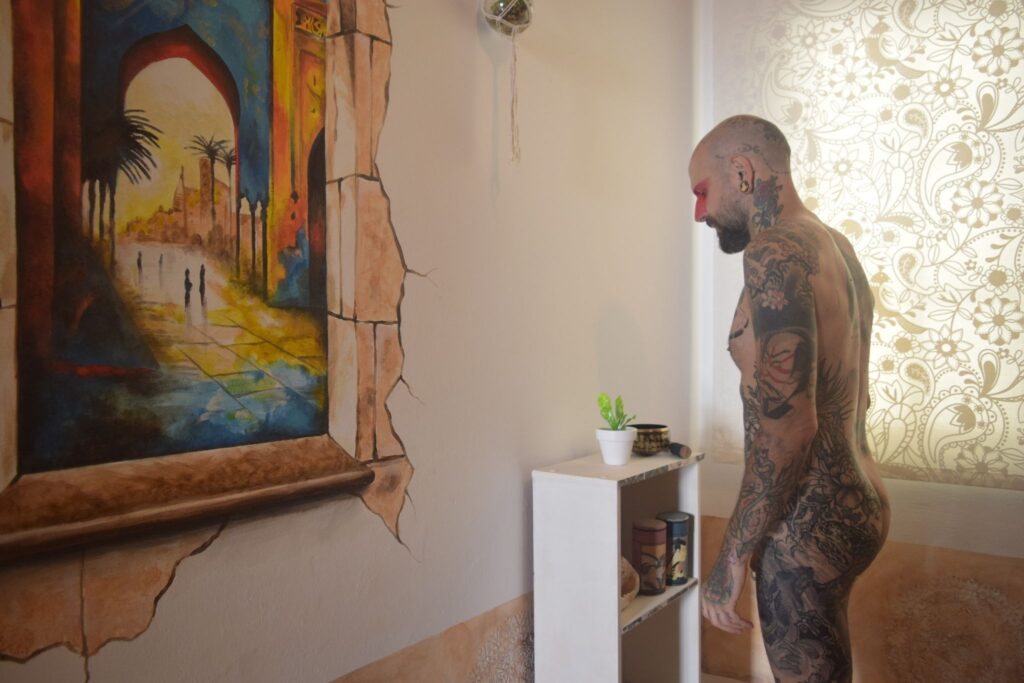
I think my background as a dancer is very present in what I do because I use lots of nudity in my art. I work almost naked on set. Because I think that the body is our primal matter. It’s what we have and the body can be everything. I use makeup and accessories and costumes only if those are a part of expression, only if they need to be there because they are part of a story. If not, I think that a body can communicate in its essence and can be everything you need. But I just don’t like to put on accessories or makeup or costumes just because it looks better, looks cool or because you need to censor your nudity. I like to work in essence, yes.
PEFF: You mentioned censorship and I do wanna talk about that. Being an artist that’s so focused on a particular medium while also wanting to convey your message, how do you try to navigate this world of censorship?
Domiziano Christopharo: I don’t know because every time it’s worse. Every day is getting worse. If you think of Instagram, for example, Instagram was born as a platform for photographers and was used by photographers for showcasing their art. And then people started to present their selfies like art because there were lots of filters. But then, I don’t know exactly when these platforms became a social media for children, because it is censored everywhere.
So, an artist that uses for example, the human body. I spoke about OnlyFans before because the idea of use OnlyFans for promoting my movie arrived because the Amsterdam Museum – and we are talking about a museum of art – had to open an OnlyFans account for publish the pictures of the statue and the paintings that they had because social media banned the accounts for a museum that published paintings of Venus or David. And a museum had to open an OnlyFans page for promoting the arts. And that from there I had the idea, okay, if they do it I can do it too. But my case is different because I use the body with horror too. And for example, blood is not allowed in porn sites, even if it’s fake, even if it’s surreal like in the way I do. So it’s funny that even the porn sites have censorship.
That’s crazy because censorship nowadays is everywhere. And many people tell me, “Oh, but it’s not true. You are exaggerating with your vision.” I say this without trying to be mean, but a regular person has a standard life that follows the rules, and doesn’t face censorship because they have no reason for doing it. But when you are an artist and use your body in dance, your body in pictures, a body in movies, you start to see “you cannot use this word / you cannot use this hashtag / you cannot publish this picture.” And you have to put stars and stickers everywhere even knowing what is natural. In Italy (I’m born in Italy) it’s even a scandal for a woman to breastfeed [in public].
We are arriving at total madness because even the most natural and innocent things related to nudity are sexualized. Sexualized like sex in any way is something horrible. My biggest shock about the censorship as a horror director is to consider, to accept, to understand that in a movie, I can easily decapitate someone, and this will be Rated R. But if you make a scene where a woman is loved, they have sex consensually, this is totally banned. So in our society, it’s more acceptable to send the message that a person can be slaughtered, than be loved. And this is crazy. This is totally crazy for me.
PEFF: One of the things I feel that can help at least continue the practice of the art that we create is word of mouth. And I would like to hear projects that you are working on next, things that are exciting you.
Domiziano Christopharo: Well, at this moment, I’m traveling this side of Europe with a butoh performance that is dedicated to the anniversary of the bombing of Hiroshima and Nagasaki. From the destruction of those two cities, also the Butoh, because it was born as an artistic movement in response to the destruction.
Now I’m traveling Europe, presenting the performance. So this is making me very happy. And this is what I’m focused on at the moment. And yes, I’m open to do short films if some cool idea happens. So, for now, my focus is on body work. I mean, dance and stage, where I can feel the contact with the audience that is getting a little bit lost in filmmaking, you know?
PEFF: Where can people find you?
Domiziano Christopharo: Well, I’m on social media like Domiziano Christopharo. I’m on Facebook, I’m on Instagram. I manage my accounts, so I love to be in touch. I think that what people miss on social media is the social part, because now it’s really like a showcase. I’m missing the fact that you can talk with people, share your opinion, receive critiques, good or bad. I think that this is the most exciting part of being social, but even social media lately is becoming a little bit asocial.
So if someone is interested in what I do and says, “Hello, I saw your short film and I think it’s terrible”, I’m really ready for the interaction!